
Publications

Towards inferring cognitive state changes from pupil size variations in real world conditions
In this paper we study how far we are from estimating cognitive state changes from eye movements in real world environments using a variety of visual search tasks
Cite
Naga Venkata Kartheek Medathati, Ruta Desai, James Hillis. Towards inferring cognitive state changes from pupil size variations in real world conditions. ETRA ‘20 Full Papers, ACM, 2020, Article 22, 1–10. doi:10.1145/3379155.3391319
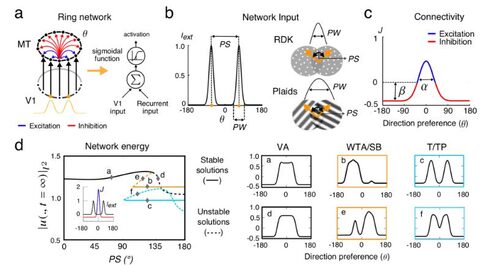
Recurrent network dynamics reconciles visual motion segmentation and integration.
This paper characterizes the complex spatio-temporal dynamics of MT neurons
Cite
N. V. K. Medathati, J. Rankin, A. I. Meso, P. Kornprobst, G. S. Masson. Recurrent network dynamics reconciles visual motion segmentation and integration. Scientific Reports 7, 11270 (2017). doi:10.1038/s41598-017-11373-z
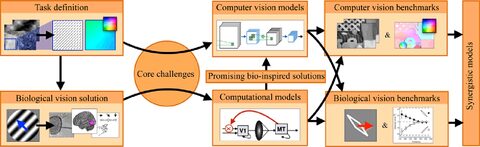
Bio-inspired computer vision: Towards a synergistic approach of artificial and biological vision
A review paper exploring the mutual benefits of biological and computer vision — how methods used to understand the visual cortex can make machine vision more robust.
Cite
N. V. Kartheek Medathati, Heiko Neumann, Guillaume S. Masson, Pierre Kornprobst. Bio-inspired computer vision: Towards a synergistic approach of artificial and biological vision. Computer Vision and Image Understanding, Volume 150, 2016, Pages 1–30. DOI: 10.1016/j.cviu.2016.04.009
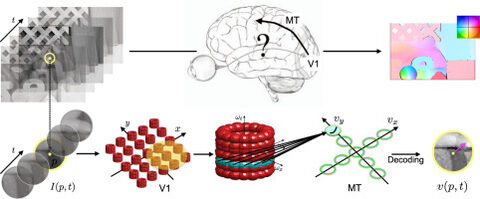
What can we expect from a V1-MT feedforward architecture for optical flow estimation?
We show how a V1-MT neural model can be adapted to handle real sequences.
Cite
Fabio Solari, Manuela Chessa, N. V. Kartheek Medathati, Pierre Kornprobst. What can we expect from a V1-MT feedforward architecture for optical flow estimation? Signal Processing: Image Communication, 39(B):342–354, 2015. doi:10.1016/j.image.2015.04.006
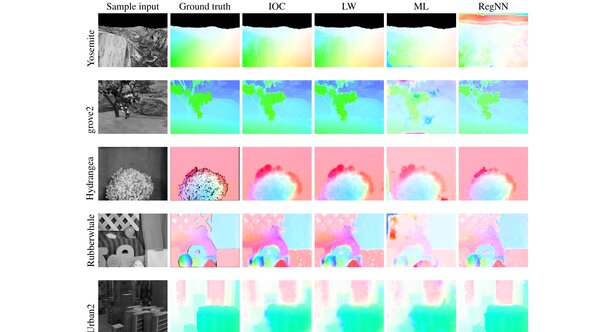
Decoding MT motion response for optical flow estimation: An experimental evaluation
Decoding the motion energies is of natural interest for developing biologically inspired computer vision algorithms for dense optical flow estimation. Here, we address this problem by evaluating four strategies for motion decoding: intersection of constraints, linear decoding through learned weights on MT responses, maximum likelihood and regression with neural network using multi scale-features.
Cite
M. Chessa, N. V. Kartheek Medathati, G. S. Masson, F. Solari, P. Kornprobst. Decoding MT motion response for optical flow estimation: An experimental evaluation. 23rd EUSIPCO, 2015, pp. 2241–2245. doi:10.1109/EUSIPCO.2015.7362783
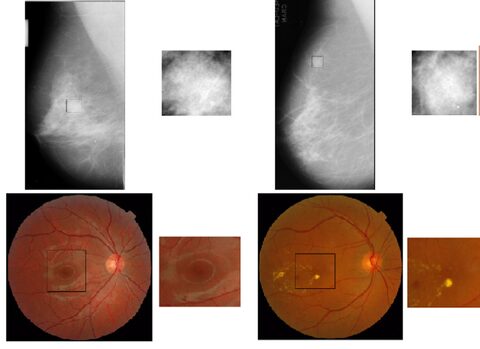
Detection and discrimination of disease-related abnormalities based on learning normal cases
In this paper, we observe the key challenges for representation and feature extraction schemes to be met for detection of abnormalities by learning normal cases.
Cite
K. Sai Deepak, N. V. Kartheek Medathati, Jayanthi Sivaswamy. Detection and discrimination of disease-related abnormalities based on learning normal cases. Pattern Recognition, 45(10):3707–3716, 2012. doi:10.1016/j.patcog.2012.03.020
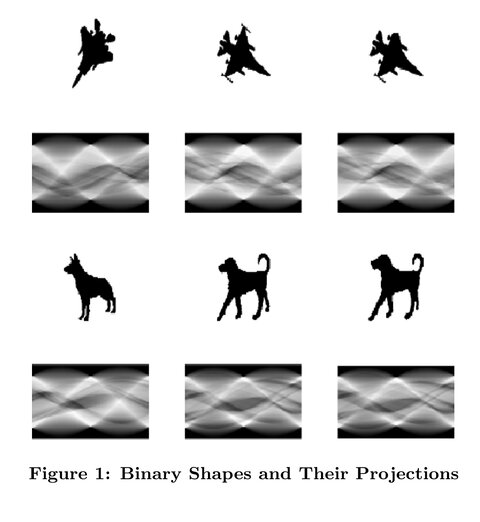
Local descriptor based on texture of projections
In this paper we propose a novel descriptor that better captures shape information by analysing texture of the radon transform
Cite
N. V. Kartheek Medathati, Jayanthi Sivaswamy. Local descriptor based on texture of projections. ICVGIP ‘10, ACM, 2010, pp. 398–404. doi:10.1145/1924559.1924612
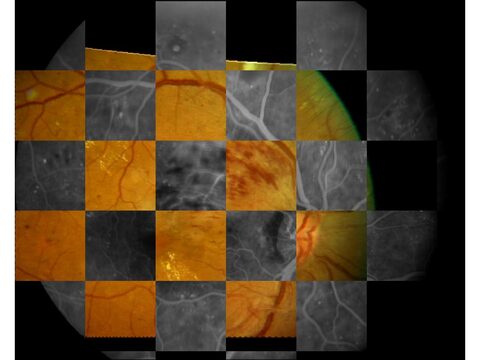
Robust matching of multi-modal retinal images using radon transform based local descriptor
A novel Radon Transform based descriptor is proposed, which is invariant to illumination, rotation and partially to scale.
Cite
Yogesh Babu Bathina, N. V. Kartheek Medathati, Jayanthi Sivaswamy. Robust matching of multi-modal retinal images using radon transform based local descriptor. IHI ‘10, ACM, 2010, pp. 765–770. doi:10.1145/1882992.1883108
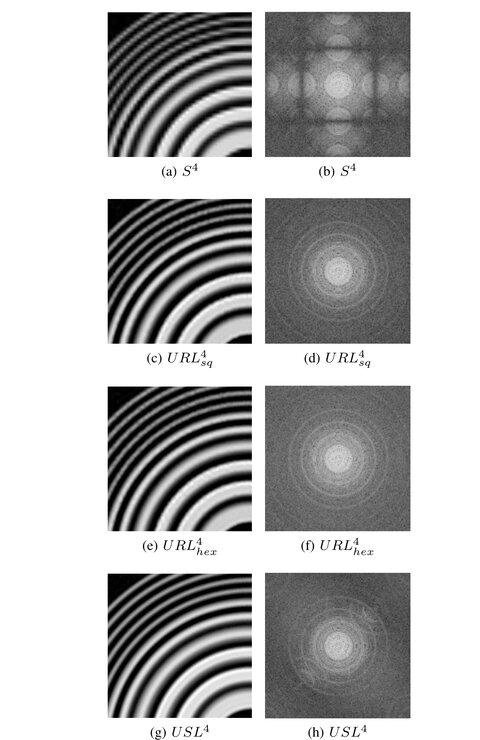
Synthetic zooming of tomographic images by combination of lattices
We propose a method for synthetic zooming of tomographic images by applying super resolution technique on reconstructed data via a union of rotated lattices.
Cite
N. Dixit, N. V. Kartheek Medathati, J. Sivaswamy. Synthetic zooming of tomographic images by combination of lattices. 2009 IEEE NSS/MIC, pp. 3770–3776. doi:10.1109/NSSMIC.2009.5401886